

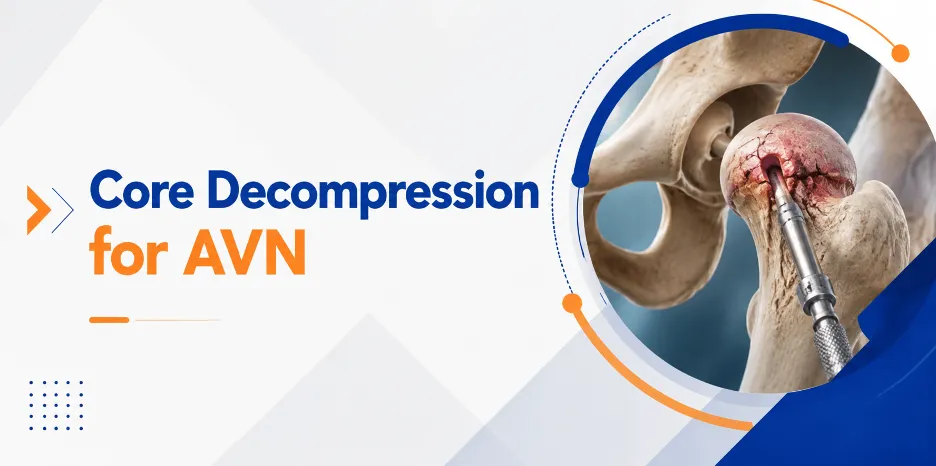
If avascular necrosis (AVN) of the hip is diagnosed in Stage 1 or early Stage 2 before the femoral head collapses, core decompression may reduce pain, improve blood flow, and delay or avoid hip replacement in selected patients. MRI is the most important test for deciding whether the procedure is likely to work.
One of the biggest advantages of diagnosing AVN early is that the natural hip joint may still be salvageable. A procedure called core decompression is designed specifically for this stage of the disease, when the blood supply has been affected but the joint has not yet collapsed.
This article explains Stage 1 and Stage 2 AVN, MRI findings, success rates, who is not suitable, recovery after surgery, and when hip replacement becomes necessary.
What Is AVN of the Hip?
AVN, also called osteonecrosis of the femoral head, occurs when the blood supply to the ball of the hip joint becomes reduced or interrupted. Without adequate blood flow, the bone tissue begins to die. Over time, the weakened bone can collapse, leading to arthritis and severe hip pain.
Common causes include:
- Long-term steroid use
- Excess alcohol consumption
- Trauma or hip fractures
- Certain blood disorders
- Autoimmune diseases
- Sometimes no clear cause is identified
In the early stages, X-rays may appear normal, which is why MRI is essential for early diagnosis.
For a broader overview of AVN and its causes, the American Academy of Orthopaedic Surgeons (AAOS) guide on osteonecrosis of the hip is a useful reference.
If you are experiencing persistent groin pain or difficulty walking, it is important to seek an assessment from a hip specialist in Navi Mumbai rather than relying only on painkillers.
Why Early Diagnosis Changes Everything

In the beginning, the bone may still maintain its normal shape even though the blood supply has been compromised. This is generally the stage at which joint-preserving procedures such as core decompression are most likely to be considered.
Once the surface of the femoral head begins to collapse, the situation changes dramatically. At that point, preserving the joint becomes much more difficult, and many patients eventually require hip replacement surgery .
Think of AVN as a disease that progresses through four broad stages:
● Stage 1: MRI changes only; X-ray normal.
● Stage 2: Bone damage visible, but no collapse.
● Stage 3: Collapse of the femoral head begins.
● Stage 4: Arthritis develops and the joint becomes severely damaged.
Core decompression is mainly considered for Stages 1 and 2.
Stage 1 AVN – The Earliest Window for Hip Preservation
In Stage 1, Some patients may have groin or hip pain, while others may have minimal or no symptoms, buttock pain, or discomfort while walking, but the X-ray usually looks normal. This is why AVN is sometimes missed initially.
MRI findings in Stage 1
- Bone marrow edema
- A low-signal band on T1 images
- Early necrotic area
- Intact femoral head surface
- No collapse
At this stage, the structure of the hip is still preserved. Core decompression is performed to reduce pressure inside the bone and the goal is to reduce intraosseous pressure and create a pathway that may support revascularisation and bone healing.
Patients are often surprised that a relatively small procedure may help preserve their own hip. However, timing is critical. Delaying treatment for months while the disease progresses can reduce the chances of success.
For patients with early symptoms, combining surgery with guided physiotherapy and hip-strengthening exercises is often an important part of recovery.
Stage 2 AVN – Still a Hip-Preserving Opportunity
Stage 2 is more advanced than Stage 1, but the joint surface remains intact.
MRI and X-ray findings
- Sclerotic changes
- Cystic areas
- Clear necrotic lesion
- No flattening of the femoral head
- No collapse of the articular surface
Patients usually experience more persistent pain and reduced walking tolerance. The hip may feel stiff after sitting for long periods.
Core decompression can still work well in carefully selected Stage 2 patients, especially when:
- The necrotic area is small to moderate
- The weight-bearing surface is preserved
- The patient is relatively young and active
- Symptoms are not severe
This is often the stage where many patients ask whether they can avoid hip replacement surgery . The answer depends largely on the MRI findings.
The Role of MRI in Treatment Planning
MRI is the single most important investigation for deciding whether core decompression is likely to help.
Dr. Avinashdev Upadhyay evaluates:
- Size of the necrotic lesion
- Location of the lesion
- Presence of bone marrow edema
- Integrity of the joint surface
- Early signs of collapse
A small lesion away from the main weight-bearing area has a much better prognosis than a large lesion involving the superior portion of the femoral head. MRI is also useful for monitoring progression after treatment. In some cases, symptoms may improve before imaging changes become obvious.
If the MRI shows advanced structural damage, procedures such as hip replacement surgery in Navi Mumbai may provide a more predictable long-term outcome.
What Happens During Core Decompression?

Core decompression is a joint-preserving surgical procedure performed through a small incision.
The procedure typically involves
- Spinal or general anesthesia
- Small incision near the hip
- X-ray guidance during surgery
- Drilling one or more channels into the necrotic area
- Sometimes bone graft or biologic augmentation is added
The surgery usually takes 30–60 minutes, and many patients go home the same day or the next day.
The goal is not to remove the entire damaged bone. Instead, the procedure reduces pressure inside the femoral head and creates a pathway for new blood vessels and healing tissue.
Success Rates – What Patients Want to Know Most
Reported outcomes vary considerably between studies. Earlier-stage disease generally has better outcomes than disease with femoral-head collapse. Success may be defined differently across studies for example, pain improvement, radiographic stability, or avoiding conversion to hip replacement. Your individual MRI findings are more important than a single percentage.
Who Is Not Suitable for Core Decompression?
Core decompression is usually not recommended when:
- The femoral head has already collapsed
- There is flattening of the joint surface
- Advanced arthritis is present
- The necrotic area is very large
- Severe loss of hip motion exists
- Pain is constant even at rest
In these situations, joint-preserving surgery is less likely to succeed, and hip replacement surgery is often the more reliable option.
Many patients worry that choosing replacement means they have failed conservative treatment. In reality, the goal is to select the treatment that offers the best long-term function and pain relief for the stage of the disease.
Recovery After Core Decompression
Recovery is gradual and requires patience.
Typical recovery timeline
| Time | What to Expect |
| Day 1–2 | Walk with support |
| 2 weeks | Wound healing |
| 4–6 weeks | Partial weight bearing |
| 6–8 weeks | Gradual full weight bearing |
| 3 months | Improved daily activity |
| 6 months | Final assessment of benefit |
Physiotherapy is often recommended to maintain hip motion and strengthen the surrounding muscles. You can learn more about physiotherapy for hip rehabilitation and how it supports recovery after hip-preserving surgery.
Can Core Decompression Completely Avoid Hip Replacement?
Sometimes yes, but not always. The best results are seen in younger patients with Stage 1 or small Stage 2 lesions. In many cases, the procedure can delay hip replacement for several years.
Factors that improve the chance of avoiding replacement:
- Early stage
- Small lesion
- No collapse
- Good bone quality
- Addressing modifiable risk factors, including alcohol use and smoking where relevant.
- Controlling underlying medical conditions
It is important to have realistic expectations. The goal is often to preserve the hip for as long as possible, not necessarily forever.
When Hip Replacement Becomes Necessary
Hip replacement is usually considered when:
- The femoral head collapses
- Arthritis develops
- Pain becomes severe
- Walking distance becomes very limited
- Sleep is disturbed by pain
- Core decompression has failed
At that stage, preserving the natural joint is often no longer realistic, and replacement becomes the more predictable solution for restoring function.
Modern techniques such as Direct Anterior Hip Replacement can provide excellent long-term outcomes with faster early recovery in selected patients.
For additional information on hip arthritis and treatment options, the Mayo Clinic AVN resource is another reliable patient reference.
Conclusion
Core decompression is one of the most important hip-preserving treatments for early AVN. It offers the best chance of delaying or avoiding hip replacement when the disease is diagnosed in Stage 1 or early Stage 2 before collapse occurs.
MRI plays a central role in deciding whether the procedure is likely to succeed. Patients with small to moderate lesions, preserved joint shape, and early symptoms are generally the best candidates.
However, once the femoral head collapses or arthritis develops, hip replacement often becomes the more predictable and effective solution.
If you have been diagnosed with AVN, the most important question is not “Do I need surgery?” but “Is my hip still in the stage where it can be saved?”
Frequently asked questions
1. Can Stage 1 AVN heal without surgery?
2. Is MRI necessary if my X-ray is normal?
3. How long does pain relief last after core decompression?
4. Can I walk immediately after surgery?
5. What is the biggest sign that hip replacement is becoming necessary?
6. Can Stage 2 AVN be treated without hip replacement?
7. What happens if core decompression fails?
References:
Disclaimer: This blog is for educational purposes only. How long a revision knee replacement lasts depends on individual factors best assessed by a surgeon.
