

PRP Injections in Navi Mumbai
Joint pain making everyday activities harder than they should be?
Platelet Rich Plasma (PRP) injections use the healing components from your own blood to support tissue repair, reduce pain, and improve function in joints, tendons, and ligaments, helping many patients return to walking, exercising, and daily activities with greater confidence.
Not sure whether PRP is right for your knee, shoulder, or tendon pain?
What Makes PRP Treatment Different?
PRP treatment is different from painkillers or steroid injections because it aims to support the body’s natural healing response rather than only masking symptoms.
The procedure usually takes 30–60 minutes. A small amount of blood is drawn from your arm, processed in a centrifuge to concentrate the platelets, and then injected into the affected area under sterile conditions. These platelets contain growth factors that may help reduce inflammation and promote tissue repair.
That difference matters for conditions such as early knee arthritis, tendon injuries, ligament sprains, and chronic overuse pain, where the goal is to improve function and delay further joint deterioration whenever possible.
For a detailed overview of PRP therapy and current evidence, see the American Academy of Orthopaedic Surgeons (AAOS) guide on PRP .
A Closer Look at How PRP Works
Understanding what PRP is helps make the treatment easier to understand.
Your blood contains several components:
Red blood cells – carry oxygen.
White blood cells – support immune function.
Plasma – the liquid portion of blood.
Platelets – contain growth factors involved in healing and tissue repair.
In PRP treatment, the platelets are concentrated to create a solution that is richer in healing factors than normal blood. When injected into a painful joint or tendon, this concentrated platelet solution is intended to support the body’s own repair mechanisms.
It is important to understand that PRP is not a stem cell treatment, and results vary depending on the condition being treated, the severity of damage, age, activity level, and overall health.
A Closer Look at How PRP Works
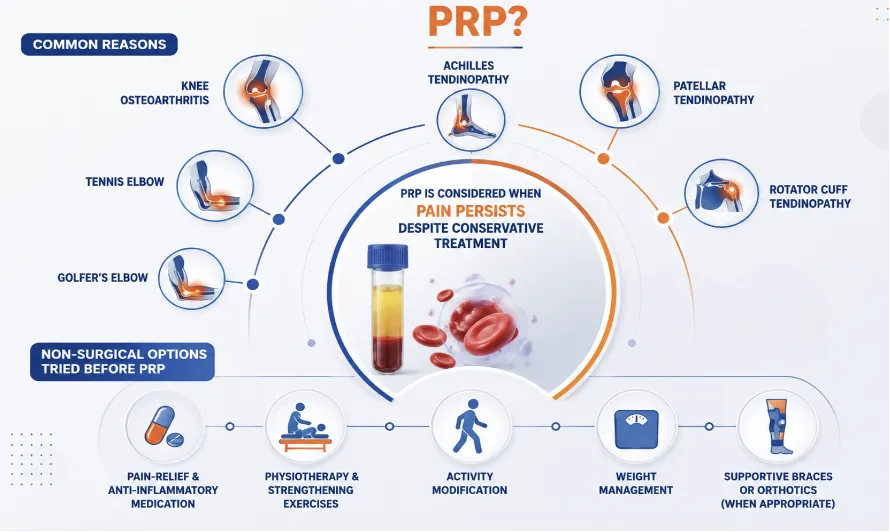
PRP is often considered when pain has persisted despite conservative treatment.
The most common reason is early to moderate knee osteoarthritis, where patients experience pain while walking, climbing stairs, or standing for long periods. Tendon problems such as tennis elbow, golfer’s elbow, Achilles tendinopathy, patellar tendinopathy, and rotator cuff tendinopathy are also frequent indications.
Before recommending PRP, Dr. Avinashdev Upadhyay usually evaluates whether non-surgical options have been tried, including:
Pain-relief and anti-inflammatory medication
Physiotherapy and strengthening exercises
Activity modification
Weight management
Supportive braces or orthotics when appropriate
PRP is generally considered when these measures have provided only partial or temporary relief.
PRP vs Steroid Injections
Neither treatment is universally “better.” The right choice depends on your diagnosis and treatment goals.
| Aspect | PRP | Steroid Injection |
| Source | Your own blood | Medication |
| Main goal | Support healing | Reduce inflammation |
| Relief onset | Gradual | Often quicker |
| Duration | May last longer in some patients | Often shorter-term |
| Best suited for | Early arthritis, tendon injuries | Acute inflammation |
Dr. Avinashdev Upadhyay will explain which option is more suitable for your condition during your consultation.
What Happens During PRP Treatment?
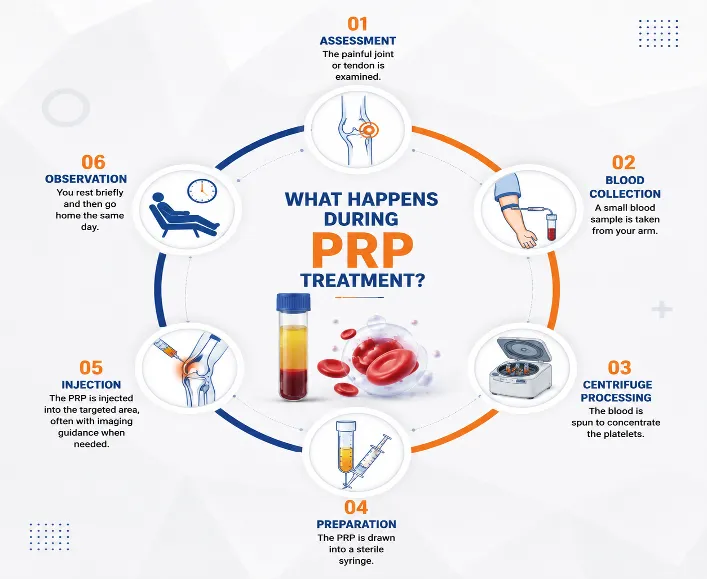
Here’s a step-by-step look at what typically happens on the day of treatment:
1
Assessment
The painful joint or tendon is examined.
2
Blood collection
A small blood sample is taken from your arm.
3
Centrifuge processing
The blood is spun to concentrate the platelets.
4
Preparation
The PRP is drawn into a sterile syringe.
5
Injection
The PRP is injected into the targeted area, often with imaging guidance when needed.
6
Observation
You rest briefly and then go home the same day.
Most patients do not require hospital admission.
What Gets Evaluated Before Recommending PRP?
Getting the diagnosis right is as important as the injection itself.
During your consultation, Dr. Avinashdev Upadhyay evaluates:
How long the pain has been present
Whether it is affecting walking, work, sports, or sleep
Severity of arthritis or tendon damage on X-ray or MRI
Previous treatments and their response
Activity level and recovery goals
General health, including diabetes and blood-thinning medications
PRP is not recommended for every patient, especially when joint damage is already advanced and replacement surgery may provide a more predictable result.
What Patients May Gain From PRP Treatment
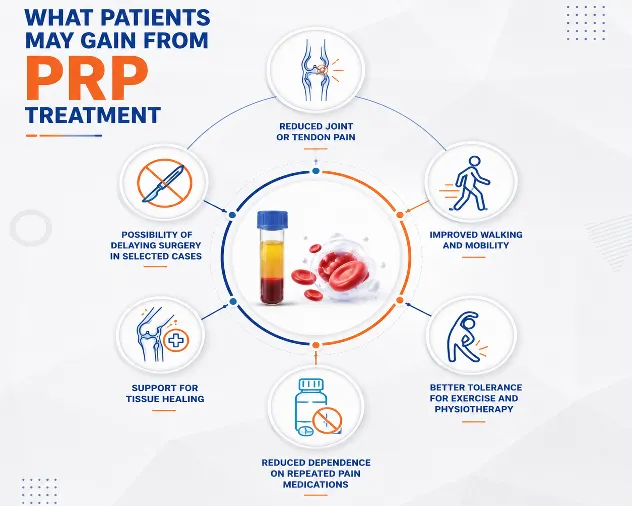
For the right patient, PRP can help improve day-to-day function.
Reduced joint or tendon pain
Improved walking and mobility
Better tolerance for exercise and physiotherapy
Reduced dependence on repeated pain medications
Support for tissue healing
Possibility of delaying surgery in selected cases
Results are usually gradual rather than immediate. Many patients notice improvement over 4–12 weeks.
Recovery Timeline: What to Expect
Every patient heals at a different pace, but this is a general guide:

Recovery varies depending on the condition treated and the injection site. Mild soreness for a few days is common. Your activity restrictions and physiotherapy plan will depend on the condition being treated. Improvement is usually gradual and may become more noticeable over several weeks.
PRP Injection Cost in Navi Mumbai
PRP treatment in Navi Mumbai may vary depending on the joint being treated, PRP preparation method, number of injections and whether imaging guidance is required. Approx cost : Rs 15000- Rs 20000 per session
“Insurance coverage for PRP varies and many policies may not cover regenerative or elective injection treatments.”
Find out whether PRP can help your knee arthritis, tendon injury, or chronic joint pain.
Is PRP Right for You?
You may be a good candidate if:
You have early or moderate knee arthritis
You have a chronic tendon injury that has not improved with physiotherapy
You want to explore non-surgical treatment options
You are active and looking to improve function
You are not yet ready for surgery
If knee arthritis has become severe with significant deformity, constant pain, and major loss of function, procedures such as Robotic Knee Replacement in Navi Mumbai may provide a more reliable long-term outcome.
Why PRP Isn’t Necessary for Everyone
PRP is a useful tool, but it is not a miracle treatment.
Some patients improve significantly, some improve moderately, and some may not experience meaningful benefit. The best results are generally seen when PRP is used for earlier-stage joint degeneration or tendon disorders, not for end-stage arthritis.
The decision should be based on a proper clinical examination, imaging findings, and a realistic discussion of expected outcomes.
Why Patients in Navi Mumbai Choose Dr. Avinashdev Upadhyay
Dr. Avinashdev Upadhyay is a fellowship-trained hip and knee replacement surgeon with advanced training in modern orthopaedic and joint-preservation treatments.
His approach is centred on selecting the least invasive treatment that is most likely to help the patient, whether that is physiotherapy, PRP, injections, or surgery when necessary.
Patients choose his practice because of:
Focused expertise in hip and knee conditions
Evidence-based treatment planning
Personalized assessment and counselling
Integration of rehabilitation with orthopaedic care
Convenient access in Seawoods and Nerul for patients across Navi Mumbai

Years Experience
Meet Your Surgeon
Why Patients Choose Dr. Avinashdev
You can learn more about his training and experience on the about us page. For general background on the technology, the American Academy of Orthopaedic Surgeons and NHS both offer independent, patient-focused information on joint replacement and surgical robotics.
Ready to explore a non-surgical option for knee, shoulder, or tendon pain?
Book your appointment with Dr. Avinashdev Upadhyay, PRP treatment specialist in Navi Mumbai.
Frequently asked questions
How many PRP injections will I need?
Many patients start with one injection, but some conditions may require a series of two or three injections depending on the severity of arthritis or tendon damage.
Is PRP treatment painful?
You may feel mild discomfort during the injection and soreness for a day or two afterward, but the procedure is generally well tolerated.
How soon will I notice improvement?
PRP works gradually. Some patients notice improvement within 2–4 weeks, while others may take 6–12 weeks to experience the full benefit.
Can PRP cure knee arthritis?
PRP does not cure arthritis or regrow a completely damaged joint. It may help reduce pain and improve function, especially in early to moderate osteoarthritis.
Is PRP safe?
Because PRP is prepared from your own blood, the risk of allergic reaction is very low. As with any injection, there is a small risk of infection, bleeding, or temporary increased pain, which is why the procedure is performed under sterile conditions.
Is PRP better than a steroid injection?
Neither treatment is right for everyone. Steroid injections may provide faster short-term relief in some conditions, while PRP may provide more gradual improvement in selected patients. The choice depends on the diagnosis, severity of the condition and treatment goals.
How long does PRP last?
The duration of benefit varies depending on the condition, severity and individual response. Some patients experience improvement for several months, while others may have shorter or longer-lasting benefits. PRP is not a permanent cure for arthritis.
Can PRP avoid knee replacement?
PRP may help selected patients with early or moderate knee arthritis manage pain and improve function, potentially delaying the need for surgery. It cannot reverse advanced arthritis or guarantee that knee replacement will be avoided.