

AVN Hip Treatment in Navi Mumbai
Groin pain that worsens with walking or standing, especially if it appeared without a clear injury?
Avascular Necrosis (AVN) of the hip occurs when blood supply to the femoral head (the ball of the hip joint) is disrupted, causing bone tissue to weaken and gradually collapse. Timely diagnosis and the right treatment approach depending on the stage of AVN can help preserve your natural hip joint or restore pain-free movement through joint replacement when needed.
Australia Fellowship-trained in Robotic Hip & Knee Replacement and advanced orthopaedic care.
Experiencing unexplained hip or groin pain? Book a consultation to check for AVN today.
Understanding AVN Hip Treatment
AVN treatment is different from routine hip pain management because the underlying problem isn’t wear-and-tear arthritis, it’s a loss of blood supply to the bone itself. This means treatment decisions depend heavily on catching the condition at the right stage, before the femoral head collapses.
In early stages, the goal is to relieve pressure inside the bone and encourage new blood vessel growth to save the joint. In advanced stages, once the femoral head has collapsed and arthritis has set in, the goal shifts to relieving pain and restoring function, often through joint replacement.
This distinction matters because early-stage AVN treated promptly can sometimes avoid or delay the need for Robotic Hip Replacement, while advanced AVN usually requires it for reliable, long-term relief.
For a detailed overview of AVN and current treatment evidence, see the American Academy of Orthopaedic Surgeons (AAOS) guide on osteonecrosis of the hip.
How Does Avascular Necrosis of the Hip Develop?

Understanding what happens inside the hip joint helps make sense of the treatment options.
The femoral head relies on a delicate blood supply to stay healthy. When this supply is disrupted due to trauma, prolonged steroid use, excessive alcohol consumption, certain blood disorders, or sometimes no identifiable cause, bone cells begin to die. Over time, this can lead to:
- Softening and weakening of the bone
- Micro-fractures within the femoral head
- Collapse of the joint surface if untreated
- Secondary arthritis of the hip
AVN is typically classified into stages (commonly Stage I to IV), ranging from early changes visible only on MRI to advanced collapse with joint space narrowing on X-ray. The stage at diagnosis strongly influences which treatment is likely to help most.
Signs You May Need AVN Hip Treatment
Most patients seek evaluation when hip or groin pain persists, worsens with weight-bearing activity, or starts limiting walking, sitting cross-legged, or daily movement.
Before deciding on a treatment approach, Dr. Avinashdev Upadhyay typically reviews:
- Activity modification and reduced weight-bearing
- Pain-relief medication
- Physiotherapy
The stage of AVN at the time of diagnosis is often the single biggest factor in deciding the right treatment path.
Core Decompression vs Hip Replacement
Neither approach is right for every patient, the choice depends almost entirely on the stage of AVN and how much of the femoral head is affected.
| Aspect | Core Decompression (Hip Preservation) | Hip Replacement |
|---|---|---|
| Best suited for | Early-stage AVN (Stage I–II), before collapse | Advanced AVN with collapse or arthritis (Stage III–IV) |
| Goal | Relieve pressure, preserve natural joint | Replace damaged joint surfaces |
| Invasiveness | Minimally invasive | Major joint surgery |
| Recovery | Shorter, but results vary | Longer, but outcomes are more predictable |
| Long-term outcome | May delay or avoid replacement | Reliable, long-term pain relief |
Dr. Avinashdev Upadhyay will confirm your AVN stage on imaging before recommending the most appropriate option.
The AVN Treatment Procedure: Step-by-Step

Diagnosis confirmation
Treatment planning
Procedure
Post-procedure care
Follow-up imaging
Rehabilitation
Can Stage 2 AVN Be Treated Without Hip Replacement?
How Dr. Avinashdev Upadhyay Diagnoses and Stages AVN
During your consultation, Dr. Avinashdev Upadhyay evaluates:
Benefits of Timely AVN Hip Treatment

AVN Recovery: What to Expect After Treatment
| Time | Core Decompression | Hip Replacement |
|---|---|---|
| Day 1–3 | Protected weight-bearing begins | Assisted standing and walking begins |
| 1–2 weeks | Gradual increase in activity | Hospital discharge, physiotherapy starts |
| 4–6 weeks | Return to light routine activities | Walking with minimal support |
| 3 months | Reassessment on imaging | Return to most daily activities |
| 6 months+ | Long-term monitoring for progression | Full functional recovery in most patients |
Your specific timeline will depend on the stage of AVN, the procedure performed, and your overall health.
AVN Hip Treatment Cost in Navi Mumbai
The total cost depends on the AVN stage, investigations, procedure required, implant choice and hospital stay. A personalized estimate is provided after reviewing your imaging and treatment plan.
“Insurance coverage for AVN treatment, including hip replacement, is often available when medically necessary, but coverage for early hip preservation procedures may vary — it’s best to confirm with your insurer.”
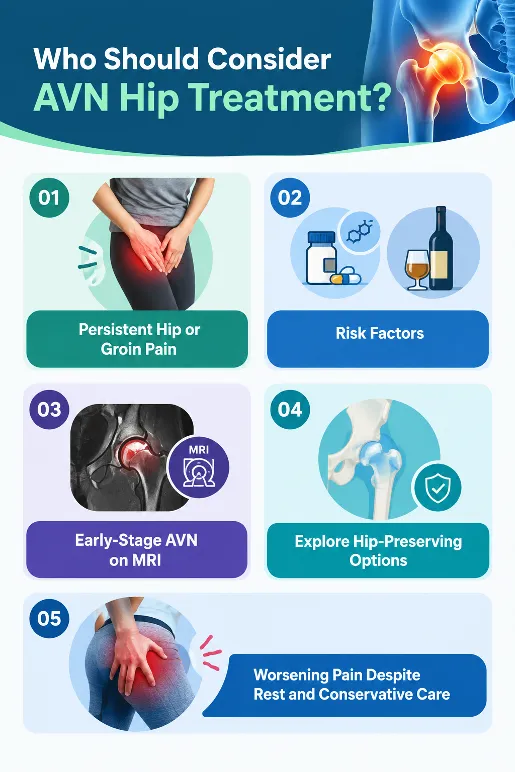
Who Should Consider AVN Hip Treatment?
You may benefit from evaluation and treatment if:
- You have persistent hip or groin pain without a clear cause
- You have risk factors such as prolonged steroid use or heavy alcohol consumption
- You’ve been told you have early-stage AVN on MRI
- You want to explore hip-preserving options before considering replacement
- Your hip pain is worsening despite rest and conservative care
If AVN has progressed to collapse or arthritis, Robotic Hip Replacement in Navi Mumbai can offer dependable, long-term relief. According to the National Institute of Arthritis and Musculoskeletal and Skin Diseases (NIAMS), early diagnosis significantly improves the range of treatment options available.
Why One Treatment Doesn't Fit All AVN Cases
AVN treatment is highly stage-dependent, which is why a one-size-fits-all approach doesn’t work.
Patients diagnosed early, with minimal femoral head involvement, often have several hip-preserving options available. Those diagnosed later, once collapse or arthritis has set in, generally do best with joint replacement rather than delayed attempts at preservation. The right decision depends on precise imaging, honest staging, and a realistic conversation about expected outcomes.
Does AVN Always Need Surgery?
No. Some small, early-stage lesions may be monitored with clinical and imaging follow-up, particularly when symptoms are limited and the risk of progression is considered low. Other patients may benefit from hip-preserving surgery before collapse. Once substantial collapse or secondary arthritis develops, hip replacement may become the more appropriate option.
Why Patients in Navi Mumbai Choose Dr. Avinashdev Upadhyay
Dr. Avinashdev Upadhyay is a fellowship-trained hip and knee replacement surgeon with advanced training in robotic joint replacement and hip preservation techniques.
His approach focuses on identifying the AVN stage accurately and recommending the least invasive option likely to help whether that’s monitoring, core decompression, or joint replacement when necessary. His approach to AVN focuses on early identification, accurate staging, assessment of lesion size and location, and selecting between observation, hip-preserving procedures and hip replacement based on the individual patient.
Patients choose his practice because of:
Focused expertise in hip conditions, including AVN
Precision-driven, robotic-assisted surgical techniques
Personalized, stage-based treatment planning
Integration of rehabilitation with orthopaedic care
Convenient access in Seawoods and Nerul for patients across Navi Mumbai

Years Experience
Meet Your Surgeon
Why Patients Choose Dr. Avinashdev
Worried about AVN progressing? Consult Dr. Avinashdev Upadhyay, AVN Hip Treatment specialist in Navi Mumbai, for a stage-wise treatment plan.
Frequently asked questions
1. What is AVN of the hip?
AVN (Avascular Necrosis) of the hip is a condition where the blood supply to the femoral head is disrupted, causing bone tissue to weaken and, if untreated, eventually collapse, leading to hip pain and arthritis.
2. Can AVN of the hip be treated without surgery?
In very early stages, AVN may be monitored with activity modification, medication, and physiotherapy. However, most confirmed cases benefit from a procedure — either hip preservation or replacement depending on the stage.
3. Is core decompression effective for AVN?
Core decompression can be effective in early-stage AVN (before collapse), as it relieves internal bone pressure and may slow disease progression. It’s less effective once significant collapse or arthritis has occurred.
4. What causes AVN of the hip?
Common causes include prolonged steroid use, excessive alcohol consumption, trauma or fracture, certain blood disorders, and in some cases, no clear cause is identified (idiopathic AVN).
5. Does AVN always lead to hip replacement?
Not always. Early-stage AVN, if diagnosed and treated promptly, may respond well to hip-preserving procedures. However, once the femoral head has collapsed, hip replacement usually becomes the most reliable treatment for lasting pain relief.
6. Can Stage 2 AVN be treated without hip replacement?
Yes, in selected patients. Stage 2 AVN is generally considered a pre-collapse stage, so hip-preserving treatment may still be possible. Depending on the size and location of the necrotic area, symptoms and other patient factors, options may include close monitoring or procedures such as core decompression, sometimes with bone grafting or other augmentation. The goal is to preserve the natural hip and delay or potentially avoid hip replacement.
7. Can AVN heal without surgery?
In some very early, small lesions, AVN may remain stable or potentially heal, but this cannot be assumed. Treatment depends on the stage, size and location of the affected area and whether the femoral head is weight-bearing. Non-surgical measures can help manage symptoms, but they do not reliably reverse established AVN. Early evaluation is important because treatment options are generally greater before femoral-head collapse.
8. How long can you live with AVN?
AVN itself usually does not shorten life expectancy. It primarily affects the bone and joint rather than vital organs. However, untreated or progressive AVN can lead to femoral-head collapse, arthritis, pain and reduced mobility. How long you can maintain a comfortable, functional hip depends on the stage of AVN, lesion size and location, underlying cause and treatment.
9. Does AVN always lead to hip replacement?
No. Not every patient with AVN requires hip replacement. Small or early-stage lesions may sometimes be monitored, while selected pre-collapse cases may be treated with hip-preserving procedures such as core decompression. If the femoral head has undergone significant collapse or secondary arthritis, hip replacement may become the more appropriate treatment.
10. Can AVN affect both hips?
Yes. AVN can affect both hips. In some patients, both hips may be involved either at the same time or at different stages. If AVN is diagnosed in one hip, the other hip may also need clinical and imaging assessment depending on the underlying cause and symptoms. MRI can detect early osteonecrosis that may not yet be visible on X-rays.
11. Can AVN come back after core decompression?
Core decompression does not guarantee that AVN will stop progressing. The procedure is intended to preserve the femoral head in appropriately selected patients, but some hips may continue to progress and eventually require further treatment or hip replacement. The risk depends on factors such as the stage, size and location of the lesion and the underlying cause of AVN.
12. When does AVN require hip replacement?
Hip replacement is generally considered when AVN has caused significant femoral-head collapse, secondary arthritis, persistent pain or substantial loss of function, particularly when hip-preserving treatment is unlikely to provide adequate benefit. The decision is based on imaging, symptoms, extent of collapse, joint condition, age, activity level and overall health not simply the AVN stage alone.
13. Is robotic hip replacement suitable for AVN?
Robotic-assisted hip replacement can be considered for selected patients with advanced AVN who require total hip replacement. The decision to use robotic assistance depends on the patient’s anatomy, imaging, surgical requirements and the surgeon’s assessment. The important first step is determining whether the natural hip can still be preserved; if replacement is required, robotic-assisted surgery may be one of the available surgical approaches.
References
- American Academy of Orthopaedic Surgeons (AAOS) – Osteonecrosis of the Hip
https://orthoinfo.aaos.org/en/diseases–conditions/osteonecrosis-of-the-hip/ - National Institute of Arthritis and Musculoskeletal and Skin Diseases (NIAMS) – Osteonecrosis
https://www.niams.nih.gov/health-topics/osteonecrosis