
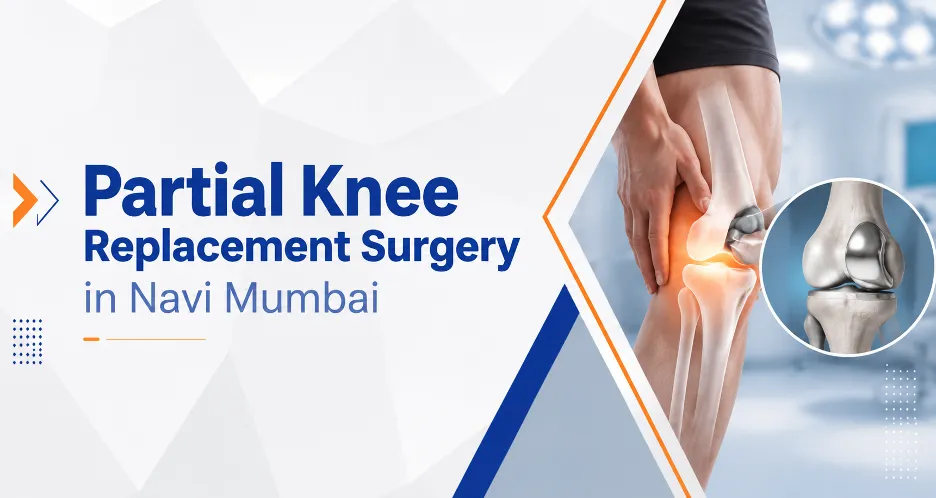
Struggling with knee pain that’s limited to just one side of your joint?
Partial Knee Replacement (also called Unicompartmental Knee Replacement) resurfaces only the damaged portion of the knee, leaving healthy bone, cartilage, and ligaments untouched. For the right candidate, it can mean faster recovery, a more natural-feeling knee, and quicker return to daily activities compared to a full knee replacement.
Australia Fellowship-trained in Robotic Hip & Knee Replacement and advanced orthopaedic care.
Wondering if Partial Knee Replacement is the right fit for your knee pain? Book a consultation today.
What Makes Partial Knee Replacement Different?
Unlike Total Knee Replacement, which resurfaces the entire joint, Partial Knee Replacement treats only the specific compartment affected by arthritis, usually the inner (medial), outer (lateral), or kneecap (patellofemoral) compartment.
The procedure typically takes 60–90 minutes and is often performed using robotic-assisted or computer-guided techniques for greater precision. Because healthy bone and both cruciate ligaments are preserved, many patients report that the knee feels more natural after surgery, with a movement pattern closer to their original joint.
This distinction matters most for patients whose arthritis is confined to one compartment, where the goal is to relieve pain and restore function while avoiding the more extensive bone removal required in total knee replacement.
A Closer Look at How Partial Knee Replacement Works
Understanding the anatomy helps explain why this surgery works for select patients.
The knee joint has three compartments:
- Medial compartment – inner side of the knee, most commonly affected by arthritis
- Lateral compartment – outer side of the knee
- Patellofemoral compartment – area behind the kneecap
In Partial Knee Replacement, only the damaged compartment is resurfaced with smooth metal and plastic components, similar to how a dentist caps a single damaged tooth rather than replacing the whole set. The healthy cartilage, bone, and ligaments in the rest of the knee are left in place, which helps preserve natural knee mechanics and proprioception (the joint’s sense of position).
It’s important to understand that Partial Knee Replacement is not suitable for every type of arthritis, results depend heavily on which compartments are affected, ligament stability, and overall joint alignment.

What Usually Leads Patients to Consider Partial Knee Replacement?

Patients typically consider this surgery when pain from one-sided knee arthritis begins interfering with daily life, walking, climbing stairs, or standing for extended periods, despite already trying conservative treatment.
Before recommending Partial Knee Replacement, Dr. Avinashdev Upadhyay usually confirms whether non-surgical and minimally invasive options have already been explored, including:
- Pain-relief and anti-inflammatory medication
- Physiotherapy and strengthening exercises
- Weight management
- Supportive braces or offloading devices
- PRP injections for early-stage joint pain
Partial Knee Replacement is generally considered when arthritis is confined to a single compartment and conservative measures no longer provide adequate relief.
Partial Knee Replacement vs Total Knee Replacement
|
Aspect |
Partial Knee Replacement |
Total Knee Replacement |
|
Extent of surgery |
One compartment resurfaced |
Entire joint resurfaced |
|
Bone & ligament preservation |
Maximum preservation |
More bone/ligament removed |
|
Incision size |
Smaller |
Larger |
|
Recovery speed |
Often faster |
Typically longer |
|
Best suited for |
Single-compartment arthritis |
Multi-compartment or advanced arthritis |
|
Knee “feel” |
Closer to natural knee |
Prosthetic feel, but very functional |
Dr. Avinashdev Upadhyay will assess your X-rays, MRI, and clinical examination to explain which option suits your knee condition.
What Happens During Partial Knee Replacement Surgery?

Here’s a step-by-step look at what typically happens on the day of surgery:
- Pre-surgical assessment – imaging and clinical evaluation confirm single-compartment arthritis.
- Anaesthesia – spinal or general anaesthesia is administered.
- Small incision – a smaller incision is made compared to total knee replacement.
- Compartment resurfacing – the damaged surfaces are precisely prepared, often with robotic assistance.
- Implant placement – metal and plastic components are fitted and aligned.
- Closure & recovery – the incision is closed, and early mobilisation begins within hours.
Most patients are encouraged to stand and take a few assisted steps on the same day or the day after surgery.
What Gets Evaluated Before Recommending Partial Knee Replacement?
Getting the diagnosis right is as important as the surgery itself.
During your consultation, Dr. Avinashdev Upadhyay evaluates:
- Which compartment(s) of the knee are affected on X-ray or MRI
- Ligament stability, particularly the ACL
- Degree of joint deformity or alignment
- Body weight and activity level
- General health, including bone quality and medical history
- Previous treatments and their response
Partial Knee Replacement is not recommended when arthritis has spread across multiple compartments, ligaments are damaged, or significant deformity is present in such cases, Robotic Knee Replacement may provide a more predictable outcome.
What Patients May Gain From Partial Knee Replacement

For the right candidate, this surgery can meaningfully improve quality of life.
- Reduced pain in the affected compartment
- Faster recovery compared to total knee replacement
- Smaller incision and less blood loss
- More natural knee movement and bending
- Shorter hospital stay in many cases
- Preserved bone stock for potential future surgery, if ever needed
Results vary by individual, but many patients resume walking without support and return to low-impact activities within a few weeks.
Recovery Timeline: What to Expect
Every patient heals differently, but this is a general guide:
|
Time |
Expected Progress |
|
Day 1 |
Assisted standing and walking begins |
|
3–5 days |
Hospital discharge for most patients |
|
2–3 weeks |
Walking with minimal support, physiotherapy continues |
|
6 weeks |
Most daily activities resumed |
|
3 months |
Return to low-impact sports and long walks |
Physiotherapy plays a central role in recovery and is tailored to your progress, fitness level, and the compartment treated.
Partial Knee Replacement Cost in Navi Mumbai
The cost of Partial knee replacement depends on whether one or both knees are being treated, the type of implant chosen, and the room category selected.
|
Package |
Approximate Cost (All Inclusive) |
|
Unilateral (Single Knee) — General Ward, Indian Implant |
2.2 lakhs to 2.4 lakhs |
|
Unilateral (Single Knee) — Private Room, Imported Implant |
2.6 lakhs to 2.8 lakhs |
|
Bilateral (Both Knees) — General Ward, Indian Implant |
4.4 lakhs to 4.6 lakhs |
|
Bilateral (Both Knees) — Private Room, Imported Implant |
5.5 lakhs to 5.7 lakhs |
Recovery Timeline: What to Expect
Every patient heals differently, but this is a general guide:
|
Time |
Expected Progress |
|
Day 1 |
Assisted standing and walking begins |
|
3–5 days |
Hospital discharge for most patients |
|
2–3 weeks |
Walking with minimal support, physiotherapy continues |
|
6 weeks |
Most daily activities resumed |
|
3 months |
Return to low-impact sports and long walks |
Physiotherapy plays a central role in recovery and is tailored to your progress, fitness level, and the compartment treated.
What’s Included in the Package:
- Room stay (General Ward or Private Room, based on package selected)
- Surgery with high-quality implants (Indian or Imported, based on package)
- Care by an experienced orthopedic surgeon team
- Hospital stay and nursing care
- OT (Operation Theatre) charges
- Medicines and consumables used during the procedure
- Pre-operative and post-operative care
“Insurance coverage typically applies for medically necessary Partial Knee Replacement, but it’s advisable to confirm specific policy terms with your insurer in advance.”
Find out whether Partial Knee Replacement can relieve your one-sided knee pain.
Is Partial Knee Replacement Right for You?
You may be a good candidate if:
- Your arthritis is limited to one compartment of the knee (usually the inner side)
- Your ligaments, particularly the ACL, are intact and stable
- You have tried conservative treatments without lasting relief
- You want a faster recovery with a smaller incision
- You are not significantly overweight and have good bone quality
If arthritis affects multiple compartments or there’s significant deformity, Total Knee Replacement is usually a more reliable long-term solution. According to the National Institute of Arthritis and Musculoskeletal and Skin Diseases (NIAMS), patient selection is one of the most important factors determining surgical success.
Why Partial Knee Replacement Isn't Necessary for Everyone
Partial Knee Replacement is a valuable option, but it’s not suitable for every patient with knee arthritis.
It works best for carefully selected patients with isolated, single-compartment disease. Attempting the procedure in patients with widespread arthritis or ligament instability can lead to poorer outcomes and earlier implant wear. The decision should always be based on detailed imaging, an examination of ligament stability, and an honest discussion of long-term expectations.
“Insurance coverage typically applies for medically necessary Partial Knee Replacement, but it’s advisable to confirm specific policy terms with your insurer in advance.”
Why Patients in Navi Mumbai Choose Dr. Avinashdev Upadhyay
Dr. Avinashdev Upadhyay is a fellowship-trained hip and knee replacement surgeon with advanced training in robotic and joint-preservation techniques.
His approach centres on choosing the least invasive procedure most likely to help each patient — whether that’s physiotherapy, PRP, partial knee replacement, or total joint replacement when necessary.
Patients choose his practice because of:

Precision-driven, robotic-assisted surgical techniques
Personalized assessment and honest counselling
Integration of rehabilitation with orthopaedic care
Convenient access in Seawoods and Nerul for patients across Navi Mumbai
Why Patients Choose Dr. Avinashdev
Ready to explore a faster, more natural recovery from knee pain? Book your appointment with Dr. Avinashdev Upadhyay, Partial Knee Replacement specialist in Navi Mumbai.
Frequently asked questions
What is the difference between Partial and Total Knee Replacement?
How long does recovery take after Partial Knee Replacement?
Is Partial Knee Replacement a permanent solution?
Can partial knee replacement be done robotically?
Can partial knee replacement be converted to total knee replacement later?
However, conversion is not inevitable. Many appropriately selected patients continue to have good function with their partial knee replacement for many years. The decision depends on the reason for failure, the condition of the implant and the remaining knee structures.
Can both knees undergo partial knee replacement?
The important point is that each knee must independently qualify for partial replacement. Having arthritis in both knees does not automatically mean that both knees are suitable for the procedure.
References
- American Academy of Orthopaedic Surgeons (AAOS) – Unicompartmental (Partial) Knee Replacement
https://orthoinfo.aaos.org/en/treatment/unicompartmental-knee-replacement/ - National Institute of Arthritis and Musculoskeletal and Skin Diseases (NIAMS) – Knee Replacement Surgery
https://www.niams.nih.gov/health-topics/knee-replacement