
Knee Replacement Surgery in Navi Mumbai
Knee arthritis making every step painful?
Robotic Knee Replacement combines advanced planning with surgical precision to restore movement and help you return to an active life.
What Is Robotic-Assisted Total Knee Replacement?
Robotic-assisted total knee replacement is an advanced form of total knee replacement where a robotic system supports the surgeon at every stage of the procedure. Before surgery, a CT scan or 3D imaging of your knee is used to build a virtual model of your joint. This helps Dr. Avinashdev Upadhyay, an Orthopedic Surgeon plan the exact size, position, and alignment of the implant based on your own bone structure, ligament tension, and leg alignment.
During surgery, the robotic arm acts as an extension of the surgeon’s hands. It does not operate on its own — Dr. Avinash controls every movement, while the robotic system provides real-time feedback and keeps bone resection within the pre-planned boundaries. This reduces the margin for error and allows for a level of soft-tissue balancing that is difficult to achieve with manual instruments alone.
Not sure if you need surgery?
How Robotic-Assisted Knee Replacement Differs From Conventional Surgery
| Aspect | Conventional Total Knee Replacement | Robotic-Assisted Total Knee Replacement |
| Surgical Planning | Based on standard implant sizing and manual jigs | Personalised 3D pre-surgical plan based on your own anatomy |
| Precision | Dependent on manual alignment tools | Robotic arm keeps bone cuts within a pre-set, patient-specific plan |
| Soft Tissue Balancing | Assessed intraoperatively by feel and experience | Assisted by real-time data on ligament tension and joint gaps |
| Implant Fit | Standardised positioning | Tailored alignment aimed at a more natural range of motion |
| Recovery Outlook | Reliable, well-established recovery timeline | Similar recovery timeline, with potential for improved comfort and implant longevity |
The Robotic-Assisted Knee Replacement Procedure
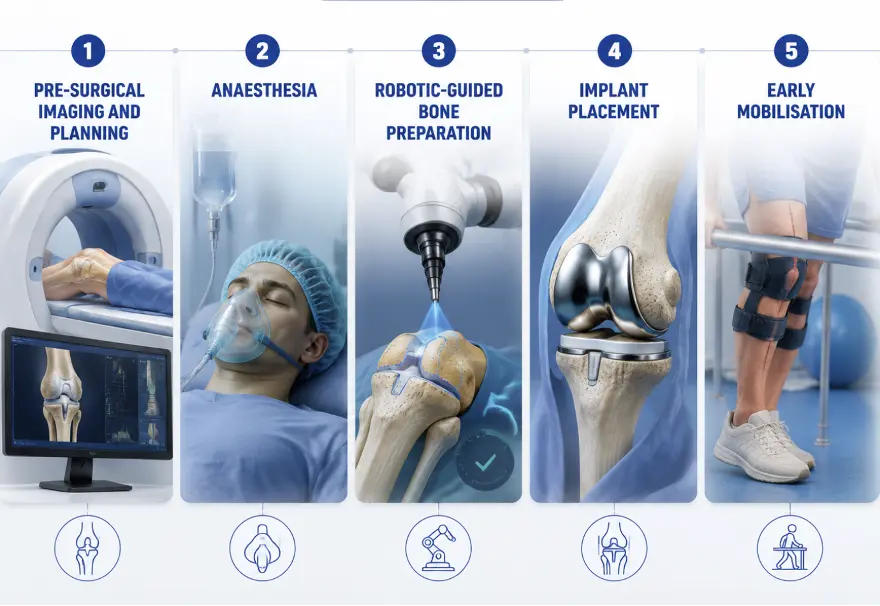
1
Pre-surgical imaging and planning
A CT scan of your knee is used to create a 3D model, from which Dr. Avinashdev Upadhyay plans implant size, position, and alignment specific to your anatomy.
2
Anaesthesia
3
The robotic arm helps position cutting guides precisely according to the pre-surgical plan, and gives real-time feedback if a movement strays outside the planned boundary.
4
Implant placement
The knee implant is fitted according to the personalised plan, with ligament balance checked and adjusted as needed.
5
Early mobilisation
Guided physiotherapy typically begins within 24 hours to help restore movement and rebuild strength.
Your Recovery Timeline
Most patients want to know one thing above all else: how soon will I be back to normal? Here’s what a typical recovery looks like after robotic knee replacement:
Every patient recovers at their own pace, and Dr. Avinashdev Upadhyay tailors your physiotherapy plan to help you hit these milestones safely.
Wondering if robotic surgery is suitable for you? Let’s evaluate your case.
Benefits of Robotic-Assisted Total Knee Replacement
1
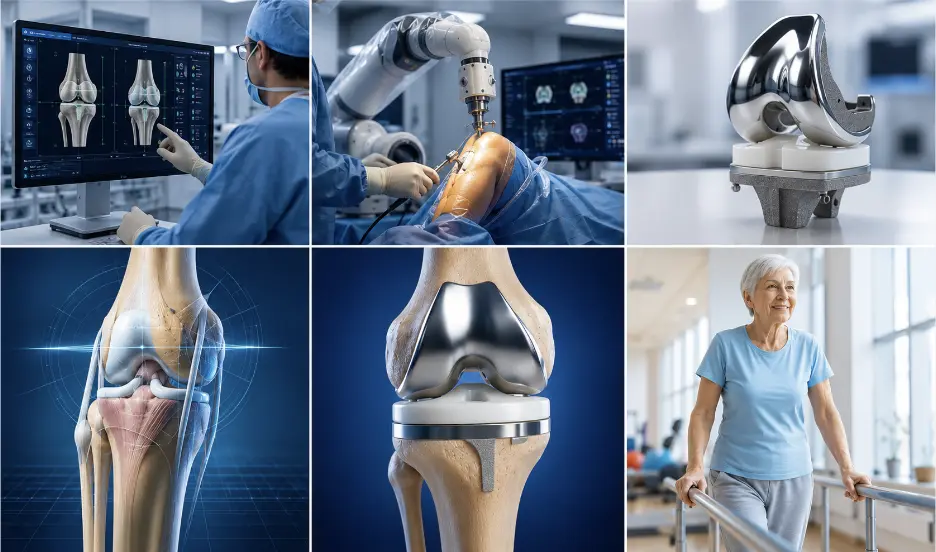
Surgery is planned around your own bone structure and joint mechanics, not a one-size-fits-all template.
2
Greater surgical precision
The robotic arm limits bone resection to the planned area, reducing the risk of over- or under-correction.
3
Improved soft-tissue balancing
Real-time data helps achieve more even ligament tension, which can translate into a more stable, natural-feeling knee.
4
Potentially longer implant life
More accurate alignment may reduce uneven wear on the implant over time.
5
Consistent, reliable recovery
Most patients follow a similar rehabilitation timeline to conventional knee replacement, with many reporting improved comfort during early recovery.
Who Is a Good Candidate for Robotic-Assisted Total Knee Replacement?
Robotic-assisted total knee replacement is generally suitable for patients with advanced osteoarthritis, rheumatoid arthritis, or post-traumatic arthritis affecting the entire knee joint, who have not found lasting relief through medication, physiotherapy, or injections. It can be particularly beneficial for patients with complex deformities or significant misalignment, where precise correction matters most.
Not every patient needs the robotic approach — for arthritis limited to a single compartment, a partial knee replacement may be more appropriate. The right recommendation depends on a detailed clinical evaluation, which Dr. Avinashdev Upadhyay provides during consultation.
Cost of Robotic Knee Replacement in Navi Mumbai
The cost of robotic-assisted total knee replacement at UMC Hospitals depends on whether one or both knees are being treated, the type of implant chosen, and the room category selected.
| Package | Approximate Cost (All Inclusive) |
| Unilateral (Single Knee) — General Ward, Indian Implant | ₹2,22,999 |
| Unilateral (Single Knee) — Private Room, Imported Implant | ₹2,66,999 |
| Bilateral (Both Knees) — General Ward, Indian Implant | ₹4,44,999 |
| Bilateral (Both Knees) — Private Room, Imported Implant | ₹5,55,999 |
A precise quote can only be given after Dr. Avinashdev Upadhyay evaluates your X-rays and clinical condition, as pricing may vary based on individual surgical needs.
|
What’s Included in the Package: |
|
Room stay (General Ward or Private Room, based on package selected) |
| Surgery with high-quality implants (Indian or Imported, based on package) |
| Care by an experienced orthopedic surgeon team |
| Hospital stay and nursing care |
| OT (Operation Theatre) charges |
| Medicines and consumables used during the procedure |
| Pre-operative and post-operative care |
Already advised knee replacement?
Bring your X-rays for a second opinion.
Why Robotic Surgery Isn't Necessary for Everyone
Robotic surgery is an excellent option for many patients, but it is not necessary in every case. During your consultation, Dr. Avinashdev Upadhyay will recommend the approach that best suits your knee, anatomy, and goals — rather than defaulting to one technique for every patient.
What Our Patients Say
Why Choose Dr. Avinashdev Upadhyay for Robotic Knee Replacement in Navi Mumbai
Dr. Avinashdev Upadhyay is a fellowship-trained hip and knee replacement surgeon, fellowship-trained in Australia in Robotic Hip & Knee Replacement, with dedicated training in advanced robotic joint replacement techniques. His approach centres on matching the right technique — robotic or conventional — to each patient’s specific anatomy and goals, rather than defaulting to one method for every case.
Focused expertise
Robotic and conventional knee replacement form the core of Dr. Avinash’s practice.
Technology-led precision
Pre-surgical 3D planning and robotic guidance are used to personalise every procedure.
Transparent guidance
Patients are walked through whether robotic assistance is likely to benefit their specific case before any decision is made.
Convenient access
Avinash consults across Navi Mumbai, including Seawoods and Nerul, serving patients from Kharghar, Thane, and nearby areas.

Years Experience
Meet Your Surgeon
Why Patients Choose Dr. Avinashdev
You can learn more about his training and experience on the about us page. For general background on the technology, the American Academy of Orthopaedic Surgeons and NHS both offer independent, patient-focused information on joint replacement and surgical robotics.
Ready to take the next step?
Book your appointment with Dr. Avinashdev Upadhyay today.
Frequently asked questions
What makes robotic-assisted knee replacement different from traditional knee replacement?
The core surgery is the same — damaged joint surfaces are removed and replaced with an implant. The difference is precision: a robotic arm guided by a personalised 3D surgical plan helps position bone cuts and the implant more accurately than manual instruments alone.
Does the robot perform the surgery on its own?
No. Dr. Avinashdev Upadhyay performs and controls the entire procedure. The robotic system acts as a precision tool, keeping bone preparation within the pre-planned boundaries and providing real-time feedback, but every surgical decision and movement is made by the surgeon.
Is recovery faster with robotic-assisted knee replacement?
Recovery timelines are generally similar to conventional total knee replacement. However, many patients report a more comfortable early recovery due to the precision of implant alignment and soft-tissue balancing achieved during surgery.
When is Total Knee Replacement surgery required?
It is recommended when knee arthritis causes severe pain, stiffness and reduced mobility that no longer responds to medication, physiotherapy, injections or other non-surgical treatment. The goal is to relieve pain and restore quality of life.
What is PRP therapy for knee pain?
PRP (Platelet-Rich Plasma) therapy uses the patient’s own blood, processed to concentrate growth factors, then injected into the knee. In selected patients with early arthritis or tendon problems, it may reduce pain and improve function.
What is robotic Direct Anterior Hip Replacement (DAA)?
A muscle-sparing, minimally invasive hip replacement done through a natural gap between muscles with robotic precision. Benefits: smaller scar, less pain, lower dislocation risk and walking often the same or next day.
When should I see a knee specialist?
Consult a specialist if knee pain lasts more than 2–3 weeks, walking or stairs become difficult, the knee swells or gives way, pain affects sleep, or medication gives only temporary relief. Early treatment can delay or avoid surgery.
What is Robotic Total Knee Replacement?
It uses advanced computer-guided technology to plan and perform the surgery with high precision, allowing accurate implant positioning and alignment — which can mean a more natural-feeling knee and a smoother recovery.
Is robotic-assisted knee replacement safe?
Yes. It is a well-established technique with a strong safety record. As with any joint replacement surgery, risks such as infection or blood clots exist but are minimised through careful pre-surgical evaluation and modern surgical protocols.
How do I know if I need robotic-assisted or conventional knee replacement?
The right approach depends on factors such as the extent of arthritis, joint alignment, and any prior injuries or deformities. Dr. Avinashdev Upadhyay will assess your knee individually during consultation and recommend the technique best suited to your anatomy and goals.
How long does a knee replacement implant last?
Modern knee replacement implants are designed to be durable and long-lasting. With proper implant positioning, good bone health, and maintaining a healthy lifestyle, many implants can last 20–25 years or longer. Longevity depends on factors such as your age, activity level, weight, and overall health. During your consultation, Dr. Avinashdev Upadhyay will discuss the most suitable implant option based on your individual needs.
Can both knees be replaced together?
Yes, both knees can be replaced during the same surgery (simultaneous bilateral knee replacement) in carefully selected patients. However, this is not suitable for everyone. The decision depends on your age, general health, heart and lung function, severity of arthritis, and fitness for surgery. Dr. Avinashdev Upadhyay will perform a detailed evaluation and recommend whether a single-stage or staged knee replacement is the safer and more appropriate option for you.
How painful is robotic knee replacement?
Some discomfort after surgery is normal, but modern pain management protocols help keep it well controlled. Robotic-assisted knee replacement itself does not eliminate pain, but its precise implant positioning and improved soft-tissue balancing may contribute to a more comfortable early recovery for many patients. Most patients begin standing and walking with the help of a physiotherapist within 24 hours of surgery. Pain levels vary from person to person, and a personalised rehabilitation programme plays an important role in recovery.