
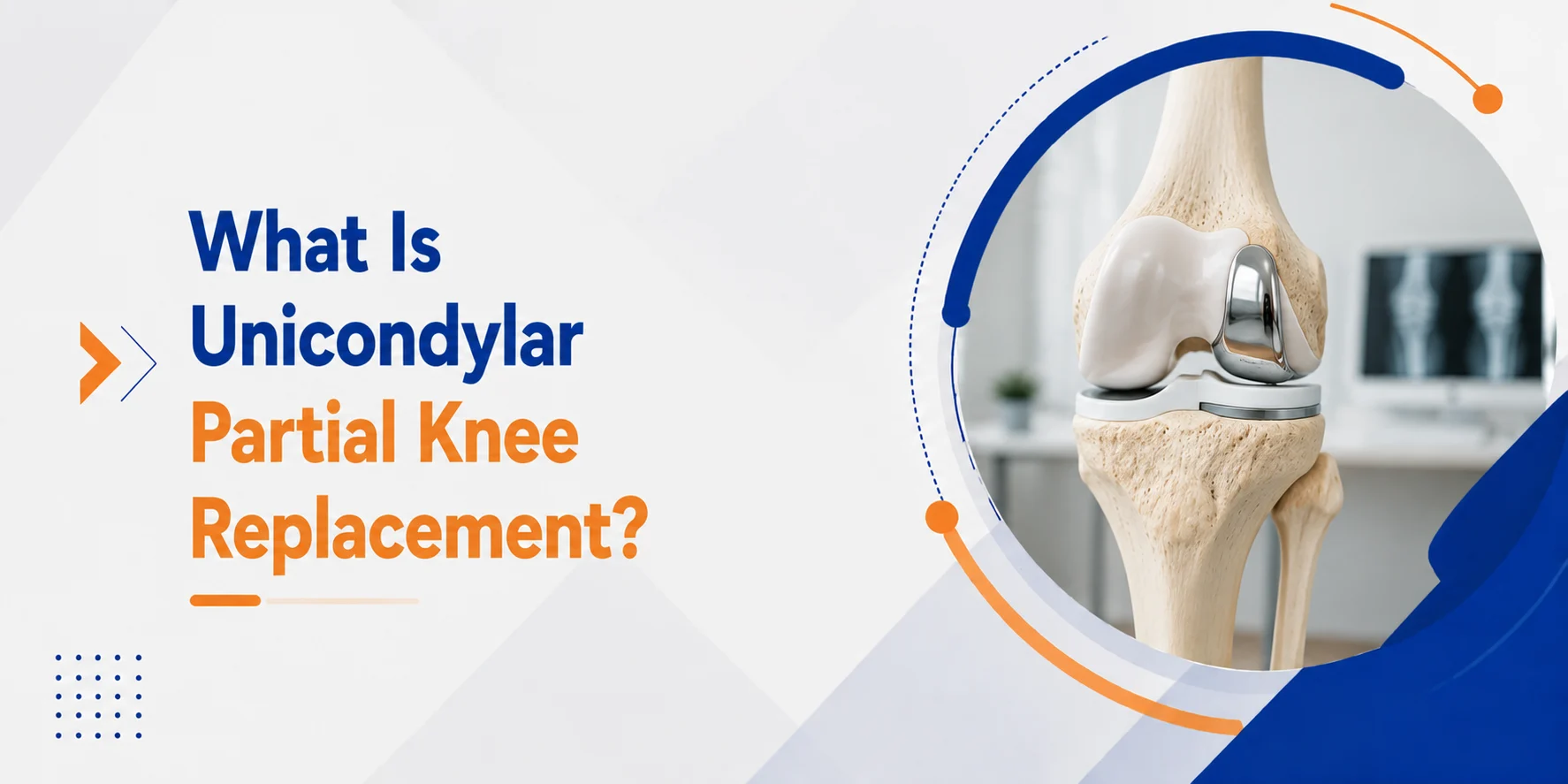
Unicondylar partial knee replacement, also called unicompartmental knee replacement, treats arthritis in just one section of the knee. Not the whole joint. The surgeon resurfaces the damaged compartment alone, with metal and plastic, and leaves the healthy bone, cartilage, and ligaments right where they are. So for patients whose damage hasn’t spread, it’s a smaller, more targeted option than a full joint replacement.
According to Dr. Avinashdev Upadhyay, an orthopedic surgeon in Navi Mumbai, “Not every arthritic knee needs a full replacement. When the damage sits in just one compartment, resurfacing that area alone often gives a more natural-feeling knee joint.”
Dr. Upadhyay’s Clinical Tip
“Patients sometimes assume partial replacement is a lesser procedure simply because less bone gets removed. In the right candidate, it isn’t a compromise. It’s actually the more conservative and appropriate choice.”
Wondering if partial knee replacement fits your case?
How Does Unicondylar Partial Knee Replacement Work?
The procedure targets the damage area directly. It doesn’t touch the parts of the joint that still work fine.
What Gets Replaced: Metal and plastic components go into the damaged compartment only. Everything else stays as it was.
Compartments of the Knee: Three compartments make up the knee, medial, lateral, and patellofemoral. The medial side wears out first, more often than not.
Bone and Ligament Preservation: Both cruciate ligaments and most of the natural bone stock stay put. Which is why the knee often keeps feeling like the patient’s own after surgery.
Recovery Advantage: Smaller incisions. Less soft tissue disruption. A shorter hospital stay and quicker return to daily life, generally, than what total knee replacement requires.
A knee that looks like a straightforward candidate on X-ray doesn’t always stay one once an MRI shows the full picture. Sometimes damage has already spread further than expected, which changes the plan. Explore robotic knee replacement with Dr. Upadhyay to see what that assessment involves.
Who Is a Good Candidate for Partial Knee Replacement?
Not every arthritic knee qualifies. That surprises more patients than you’d think.
Localized Arthritis: The imaging has to show damage limited to one compartment. Once it spreads, a partial approach usually gets ruled out.
Ligament Health: A stable, intact ACL matters here, because the implant depends on the knee’s own ligaments to stay supported.
Age and Activity Level: Younger, active patients tend to lean toward partial replacement. Quicker recovery, more natural movement afterward.
When Total Is Better: Multi-compartment damage. Real deformity. Unstable ligaments. Any one of these usually points toward a total replacement instead.
Knowing where non surgical options run out helps clarify when surgery becomes the right next step. Read more on can I use an Indian toilet after knee replacement for what recovery actually looks like.
Why Choose Dr. Avinashdev Upadhyay for Partial Knee Replacement?
Dr. Avinashdev Upadhyay has performed 500+ joint replacements spanning partial, total, and revision procedures. He’s fellowship trained in robotic assisted knee surgery, and that same precision carries into how he identifies exactly which compartment is damaged before recommending a plan. Every case starts with detailed imaging. Because a knee suited to partial replacement and one that needs a total replacement can look deceptively similar on the surface.
Wherever a partial approach can give the same relief with less disruption, that stays the preferred route. This imaging-led, precision-first approach is what lets many patients keep more of their natural knee while still getting lasting pain relief. Call +91 93260 59062 to discuss your options.
Patient Stories
Frequently asked questions
1. What is the difference between partial and total knee replacement?
Partial replacement resurfaces just the damaged compartment and leaves the rest of the knee, bone and ligaments included, untouched. Total replacement resurfaces the whole joint.
2. How long does recovery take after unicompartmental knee replacement?
It’s usually quicker than total knee replacement. Most patients are walking with support within a day and back to daily activities within a few weeks.
3. Can partial knee replacement be converted to total knee replacement later?
It can be. If arthritis spreads to the other compartments down the line, a partial replacement can be revised into a total one when the time comes.
4. Who is not a good candidate for partial knee replacement?
Anyone with damage across multiple compartments, knee deformity, or unstable ligaments. Total knee replacement tends to be the better fit there.
References:
Disclaimer: This blog is for educational purposes only. Whether partial knee replacement is suitable depends on individual imaging and evaluation by a specialist.