
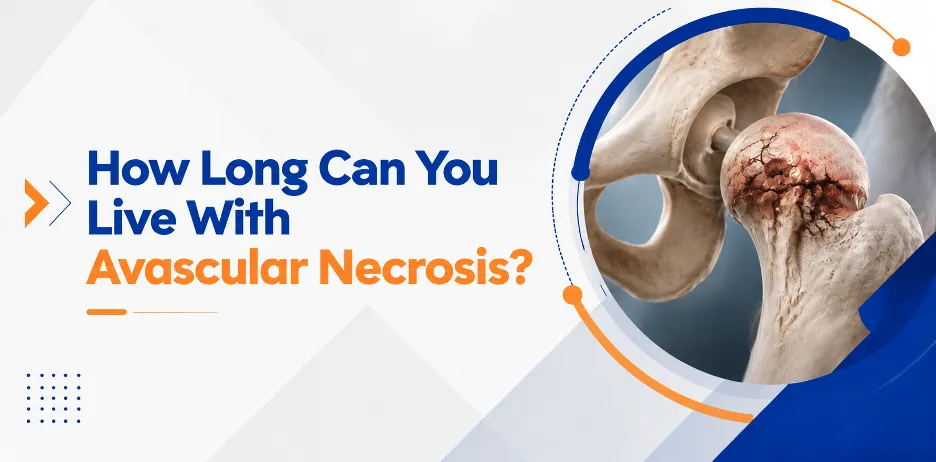
Avascular necrosis (AVN) does not shorten your overall life expectancy, it’s a bone and joint condition, not a life-threatening disease. However, if left untreated, it can progressively worsen over months to years, eventually leading to joint collapse, arthritis, and significant pain. How long you can live comfortably with AVN, and how much it affects your daily life, depends heavily on the stage at diagnosis and how early treatment begins.
Getting an AVN diagnosis often brings a wave of anxiety, and one of the first questions many patients ask is, “How long can I live with this?” It’s a natural fear, but the good news is that AVN itself is not fatal. The real concern isn’t survival, it’s how the condition affects your joint function, mobility, and quality of life over time if it isn’t managed properly.
An Orthopedic Surgeon breaks down what actually happens as AVN progresses, how long each stage typically takes, what determines your long-term outlook, and when to seek treatment before the joint reaches a point of no return.
AVN Explained: Why It Happens and Where It Strikes

Common causes include:
● Long-term steroid use
● Excessive alcohol consumption
● Trauma or fractures near a joint
● Certain blood disorders and clotting conditions
● Autoimmune diseases
● Sometimes, no clear cause is ever identified
Importantly, AVN is a localized bone condition. It does not spread through the body or affect other organs, which is why it does not directly reduce life expectancy the way a systemic or malignant disease might.
Does AVN Actually Shorten Life Expectancy?
AVN affects bone and joint health, not vital organ function. People diagnosed with AVN, even in advanced stages, generally have a normal life expectancy. The real impact of AVN is on quality of life, pain, mobility, and independence rather than lifespan.
That said, some underlying conditions associated with AVN (such as certain autoimmune diseases or blood disorders) may carry their own health implications. It’s the underlying cause, not the AVN itself, that occasionally needs closer medical attention.
For a broader clinical overview of the condition, the American Academy of Orthopaedic Surgeons (AAOS) guide on osteonecrosis of the hip is a useful reference.
What Happens If AVN Is Left Untreated?

While AVN won’t shorten your life, ignoring it can significantly worsen your joint over time. Left untreated, the disease tends to follow a predictable path:
- Bone tissue continues to weaken due to poor blood supply
- Micro-fractures develop within the affected bone
- The joint surface eventually begins to collapse
- Secondary arthritis sets in as the joint surface becomes irregular
- Pain becomes more constant, and mobility declines
This progression can happen over months in some patients, or take a few years in others — there’s no fixed timeline. What’s consistent is that once collapse occurs, hip preservation options like core decompression surgery become far less effective, and joint replacement often becomes the more realistic path forward.
What Determines How Fast AVN Progresses?

● Size and location of the necrotic area – larger lesions, especially in weight-bearing zones, tend to progress faster
● Stage at diagnosis – earlier-stage AVN generally has a slower, more manageable course
● Ongoing risk factors – continued steroid use or alcohol consumption can accelerate damage
● Weight-bearing activity – high-impact activity on an affected joint may speed up collapse
● Underlying medical conditions – conditions like clotting disorders can influence disease behaviour
● Age and bone quality – younger, healthier bone sometimes responds better to hip-preserving treatment
This is why two patients with a similar initial diagnosis can have very different outcomes a year later.
The Four Stages of AVN and What Each Means for You
AVN is typically classified into four stages, and your long-term outlook depends largely on which stage you’re in when diagnosed:
|
Stage |
Description |
Long-Term Outlook |
|
Stage 1 |
MRI changes only; X-ray normal |
Best chance of joint preservation |
|
Stage 2 |
Bone damage visible, no collapse |
Still a strong window for hip-preserving treatment |
|
Stage 3 |
Femoral head begins to collapse |
Preservation becomes difficult |
|
Stage 4 |
Arthritis develops, joint severely damaged |
Joint replacement usually needed |
Patients diagnosed and treated in Stage 1 or Stage 2 often go on to live for decades with a functional, pain-managed joint, sometimes avoiding replacement altogether or delaying it significantly.
Can You Live a Full, Active Life With AVN?
Yes, many patients with AVN go on to live fully active lives, especially with timely diagnosis and appropriate treatment.
In early stages, patients who undergo hip-preserving procedures or manage the condition with medication, activity modification, and physiotherapy often maintain good function for years. Even in more advanced stages, joint replacement surgery is highly effective at restoring pain-free movement and allowing patients to resume most normal activities.
The key isn’t whether you can live with AVN, it’s whether you catch it early enough to have more treatment options available.
How Long Before AVN Typically Leads to Joint Replacement?
● Untreated Stage 1–2 AVN may progress to collapse within 1–3 years in many cases, though this varies widely
● Treated early-stage AVN (with core decompression or other preservation methods) can delay or avoid replacement for many years, sometimes indefinitely
● Stage 3–4 AVN often requires hip replacement surgery within a relatively short timeframe, as the joint surface is already compromised
The takeaway: earlier evaluation and treatment genuinely change how long you can preserve your natural joint before replacement becomes necessary.
Managing Life With AVN Day to Day

Whether you’re in an early stage under observation or recovering from treatment, a few practices can help manage AVN long-term:
- Avoiding high-impact activities that stress the affected joint
- Maintaining a healthy weight to reduce joint load
- Limiting alcohol consumption and avoiding unnecessary steroid use
- Following a structured physiotherapy routine to maintain strength and mobility
- Attending regular follow-up imaging to monitor for progression
These steps don’t cure AVN, but they can meaningfully slow progression and improve day-to-day comfort.
When Should You See a Specialist?

● Persistent groin, hip, or buttock pain, especially without a clear injury
● Pain that worsens with walking or standing
● Stiffness after sitting for long periods
● A known risk factor, such as long-term steroid use, combined with new joint pain
● A previous AVN diagnosis with worsening symptoms
According to the Mayo Clinic’s resource on avascular necrosis, early diagnosis and treatment offer the best chance of preventing further bone damage reinforcing why timely evaluation matters more than the stage itself.
The Bottom Line on Living With AVN
Avascular necrosis will not shorten your lifespan, but it can significantly affect your joint health and quality of life if left unmanaged. The real question isn’t “how long can I live with AVN” — it’s “how much of my natural joint function can I preserve, and for how long.”
Early-stage AVN, caught before collapse, offers real opportunities for joint preservation. Later-stage AVN is very treatable too, just through a different path, joint replacement that reliably restores function and comfort.
Frequently asked questions
Is avascular necrosis a life-threatening disease?
How long can AVN go untreated before it becomes serious?
Can AVN stay stable without ever needing surgery?
Does AVN come back after treatment?
What is the best age to get AVN treated?
Can Avascular Necrosis Heal on Its Own?
Can Stage 2 AVN Be Treated Without Hip Replacement?
Can Young People Live Normally With AVN?
When is hip replacement necessary?”
Medically reviewed by Dr. Avinashdev Upadhyay – Consultant Orthopaedic & Joint Replacement Surgeon, Fellowship Trained in Australia, Hip & Knee Specialist.