
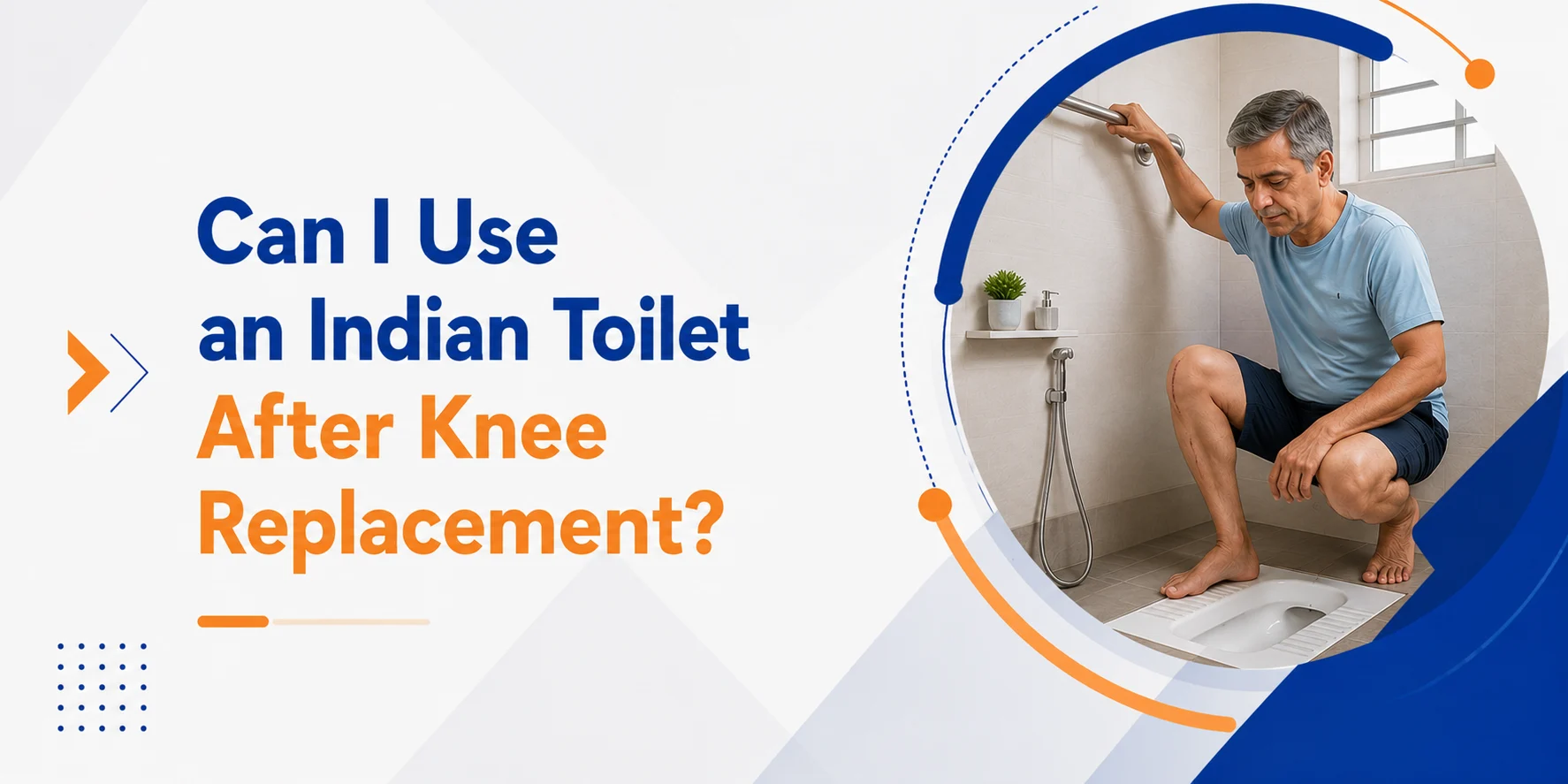
Indian toilets require a squatting posture that places heavy load on a knee still healing from surgery. That squat bends the knee well past 90 degrees exactly when fresh tissue and the new implant need protection. For the first two to three months after knee replacement most surgeons recommend a Western toilet or a commode chair placed over the Indian toilet instead. This single change during early recovery prevents a surprising number of avoidable setbacks.
According to Dr. Avinashdev Upadhyay, an orthopedic surgeon in Navi Mumbai, “The knee needs time before it can trust deep bending again. Rushing back into a squat is one of the easiest ways to slow recovery down.”
Dr. Upadhyay’s Clinical Tip
“One of the biggest mistakes I see is patients testing an Indian toilet simply because they can bend the knee during physiotherapy. Controlled exercises and a full body-weight squat are very different movements.”
Not sure which toilet setup fits your recovery stage?
Why Is Deep Squatting Risky After Knee Replacement?
The risk comes down to angle and timing more than the toilet itself.
Squatting Depth: An Indian toilet demands full knee flexion often beyond 120 degrees, far more than most fresh implants can handle safely in the early weeks. That depth places direct pressure on healing tissue and on muscles still regaining strength. Even a brief attempt at this range can set recovery back by days.
Timing: The first two to three months carry the highest risk since the surrounding bone and soft tissue are still settling into place. Patients who feel confident walking normally can still be far from ready for a full squat during this window.
Partial vs Total Knee Replacement: Partial knee patients often regain deep flexion sooner since less tissue was disturbed and the natural joint surfaces are largely preserved. Total knee replacement patients generally need a longer, more cautious timeline since a larger portion of the joint has been replaced.
Robotic Knee Replacement: Robotic precision improves implant alignment and can support a smoother recovery curve by reducing soft tissue trauma during surgery. It does not remove the need for a gradual, supervised return to deep positions like squatting.
Robotic accuracy still works alongside a careful recovery plan built around your specific healing pace. Learn more about robotic knee replacement with Dr. Upadhyay.
What Are Safe Alternatives During Knee Replacement Recovery?
The goal is comfort and safety without forcing the joint too soon.
Safe Techniques: Grab bars and a raised toilet seat cut down how far the knee bends during transfers. Keep movements slow, with support close by, especially on late-night trips to the bathroom.
Alternatives During Recovery: A Western toilet, or a commode chair placed over the Indian one, removes deep squatting entirely in early healing. It’s a small change that spares real strain without upending daily routines.
Gradual Return: Once your surgeon clears you, ease into partial squatting rather than jumping straight to a full one. Physiotherapy targets knee bending, quadriceps strength, balance and confidence, the same qualities a full squat eventually needs.
Warning Signs: Swelling, sharp pain, or instability during a squat attempt mean it’s too soon, not a setback to push through. Treat them as the body asking for more healing time.
Here’s roughly how that timeline plays out for most patients:
|
Recovery Stage |
Toilet Recommendation |
|
0–6 weeks |
Western toilet or commode chair only |
|
6–12 weeks |
Continue raised toilet seat if needed |
|
3 months+ |
Gradual squatting only after surgeon clearance |
|
Long-term |
Many patients return to Indian toilets depending on knee flexibility and strength |
A tailored recovery plan makes this transition far easier to manage, and the same deep flexion caution applies elsewhere in recovery too, including sitting cross legged after hip replacement for patients recovering from both procedures.
Why Choose Dr. Avinashdev Upadhyay for Knee Replacement Recovery?
Dr. Avinashdev Upadhyay has spent over 10 years performing joint replacements, with 500+ procedures across partial, total and robotic assisted knee surgery. Trained in robotic knee replacement in Australia, he leans on techniques that protect the surrounding tissue and support a faster, safer recovery. Patients get a recovery roadmap built around their actual healing rather than a generic timeline copied from someone else’s case.
That translates into real guidance on toilet use, squatting timelines and physiotherapy steps, adjusted as recovery unfolds rather than fixed on day one. Call +91 93260 59062 to plan your recovery.
Patient Stories
Frequently asked questions
1. When can I use an Indian toilet after knee replacement?
Usually after two to three months once your surgeon confirms healing.
2. Is squatting safer after partial knee replacement?
Yes, partial knee replacement often allows earlier and easier deep bending.
3. Can robotic knee replacement speed up recovery?
It improves alignment and precision but recovery timing still depends on healing.
4. What can I use instead of an Indian toilet early on?
A Western toilet or a commode chair placed over it works well.
References:
Disclaimer: This article is for educational purposes only. If you notice pain, swelling or instability while squatting after surgery, contact your surgeon promptly.