
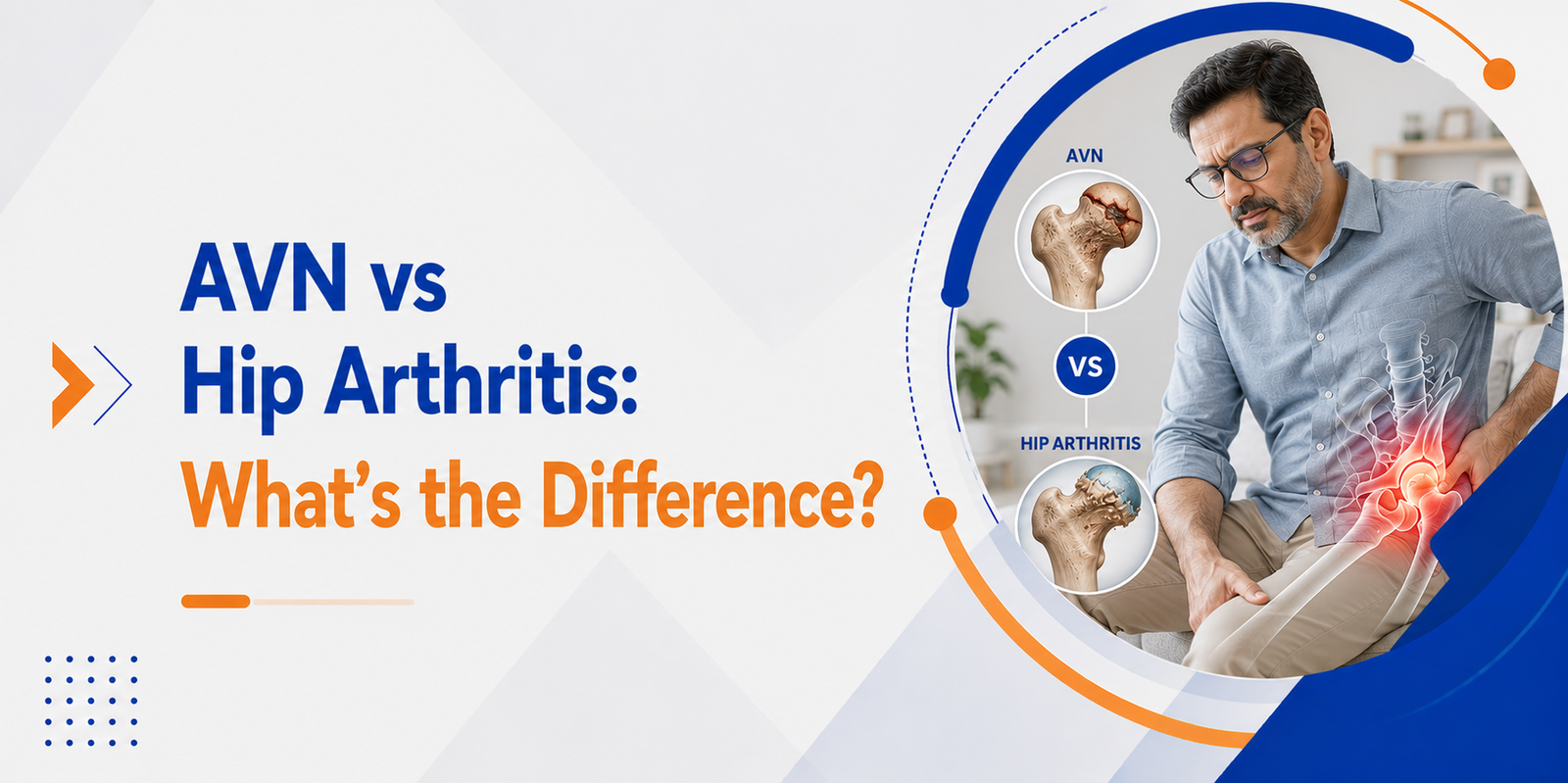
Avascular Necrosis (AVN) and hip arthritis get mixed up a lot. Both eventually bring hip pain and stiffness, but the damage starts in completely different places. AVN begins when blood supply to the femoral head gets cut off, and that section of bone starts dying from the inside out. Hip arthritis works differently, wearing down the cartilage that cushions the joint surfaces over time. Left alone, AVN can progress to bone collapse. And that collapse often triggers a secondary form of arthritis in the very same joint.
According to Dr. Avinashdev Upadhyay, an orthopedic surgeon in Navi Mumbai, “Patients often assume hip pain in their thirties or forties has to be arthritis. In a fair number of cases, it’s actually AVN, and that distinction changes the entire treatment plan. Getting it wrong doesn’t just delay relief, it can push the joint past the point where the natural bone could’ve been saved.”
Dr. Upadhyay’s Clinical Tip
“If you’re under 50 and have persistent groin or hip pain without a major injury, don’t assume it’s just muscle strain or early arthritis. Early evaluation can detect conditions like AVN before permanent joint damage occurs.”
Not sure if your hip pain is AVN or arthritis?
AVN vs Hip Arthritis: How Do They Compare?
Feature by feature, the two conditions barely overlap.
|
Feature |
AVN |
Hip Arthritis |
|
Underlying Cause |
Loss of blood supply to the femoral head |
Gradual wear of joint cartilage |
|
Typical Age Group |
Often 30s to 50s |
Usually 50s and above |
|
Onset Speed |
Can progress within months |
Usually develops over years |
|
Early X-ray Findings |
Often normal, MRI needed |
Joint space narrowing visible |
|
Cartilage Involvement |
Secondary, appears after bone collapse |
Primary driver of the damage |
|
Treatment Focus |
Preserve blood supply and bone shape |
Manage wear and joint mechanics |
Underlying Cause: AVN starts as a circulation problem. Not a wear problem. Blood flow gets disrupted and bone tissue in that area begins dying, regardless of how much the joint’s actually been used.
Onset Speed: AVN can move from early symptoms to real bone damage within months if it’s left untreated. Hip arthritis builds slowly instead, over years of everyday use.
Diagnosis Differences: Early AVN often looks completely normal on a standard X-ray because bone changes may not be visible until the disease has progressed. MRI becomes essential once AVN is suspected. Arthritis, on the other hand, usually shows visible joint space narrowing by the time it gets symptomatic.
Treatment Focus: AVN treatment centers on protecting blood supply and bone shape before collapse happens. Arthritis treatment goes a different route entirely, managing wear, inflammation, and joint mechanics over the long haul.
Because AVN is a circulation problem first, treatment aims to step in before the joint changes shape. Explore Direct Anterior Hip Replacement with Dr. Upadhyay for cases where collapse has already occurred.
Why Does the Distinction Between AVN and Arthritis Matter?
Getting the diagnosis right early changes what treatment can still achieve.
Secondary Arthritis Risk: Once AVN causes the femoral head to collapse, the joint surface turns uneven, and arthritis often follows as a direct result. Treating AVN early can prevent that second problem entirely.
Treatment Timing: AVN has a real window where joint preserving treatment works. But that window closes once collapse begins, and there’s no going back after that. Arthritis has no equivalent early window, since the damage is already cartilage based by the time it’s caught.
Diagnostic Approach: A clinician suspecting AVN in a younger patient with normal X-rays will typically order an MRI rather than wait for more symptoms to show up. Arthritis diagnosis leans more heavily on X-ray findings alone.
When to See a Specialist: Hip pain in someone under 50, especially with risk factors like steroid use or heavy alcohol intake, deserves an AVN focused workup. Not an automatic arthritis label.
Understanding what actually causes AVN explains why some patients face this risk more than others. Read more on what causes AVN in young adults for the fuller picture.
Why Choose Dr. Avinashdev Upadhyay for AVN and Hip Care?
Dr. Avinashdev Upadhyay has evaluated and treated thousands of hip patients across both AVN and arthritis, and getting the diagnosis right is always step one. Fellowship trained in robotic joint replacement in Australia, he brings that same precision to MRI based AVN staging and long term arthritis management alike.
Whichever condition is actually driving the pain, treatment starts with that answer, not a guess. Call +91 93260 59062 to schedule your evaluation.
Patient Stories
Frequently asked questions
1. What is the main difference between AVN and hip arthritis?
AVN is caused by a loss of blood supply to the bone, while hip arthritis comes from gradual wear of the joint cartilage. They start from completely different processes even though both can cause hip pain.
2. Can AVN turn into arthritis?
Yes. If AVN progresses to bone collapse, the uneven joint surface that results often leads to secondary arthritis in the same hip.
3. Does AVN show up on a normal X-ray?
Not always. Early AVN often looks normal on X-ray, which is why MRI is usually needed to confirm or rule it out.
4. Who is more likely to get AVN versus arthritis?
AVN tends to affect younger adults, often in their 30s to 50s, while arthritis is more common after 50 due to years of joint wear.
References:
Disclaimer: This blog is for educational purposes only. If you have persistent hip pain, consult a specialist for an accurate diagnosis.